•   HOME
  •   SELECTED WORKS
    •    knoll house
    •    bridge house
    •   ten roofs
    •    meadow house
    •    angle house
    • angle house addition
    •   the sanctuary
    •    valley house
    •   tractor house
    •   lake house
    •   pure metal house
    •   monastery
    •   furniture
    •   in process
  •  GUIDING PRINCIPLES
  • THE SOCIABLE KITCHEN
  • PASSIVE SOLAR DESIGN
  •   PRESS
  • ABOUT
  •   CONTACT
  •   LOG IN

Chris Larson architect

Designing people- and earth-friendly custom homes since 1986
  •   HOME
  •   SELECTED WORKS
    •    knoll house
    •    bridge house
    •   ten roofs
    •    meadow house
    •    angle house
    • angle house addition
    •   the sanctuary
    •    valley house
    •   tractor house
    •   lake house
    •   pure metal house
    •   monastery
    •   furniture
    •   in process
  •  GUIDING PRINCIPLES
  • THE SOCIABLE KITCHEN
  • PASSIVE SOLAR DESIGN
  •   PRESS
  • ABOUT
  •   CONTACT
  •   LOG IN

  •   HOME
  •   SELECTED WORKS
    •    knoll house
    •    bridge house
    •   ten roofs
    •    meadow house
    •    angle house
    • angle house addition
    •   the sanctuary
    •    valley house
    •   tractor house
    •   lake house
    •   pure metal house
    •   monastery
    •   furniture
    •   in process
  •  GUIDING PRINCIPLES
  • THE SOCIABLE KITCHEN
  • PASSIVE SOLAR DESIGN
  •   PRESS
  • ABOUT
  •   CONTACT
  •   LOG IN
cld7.jpg

knoll house photos: david dietrich

Knoll House, Candler, North Carolina

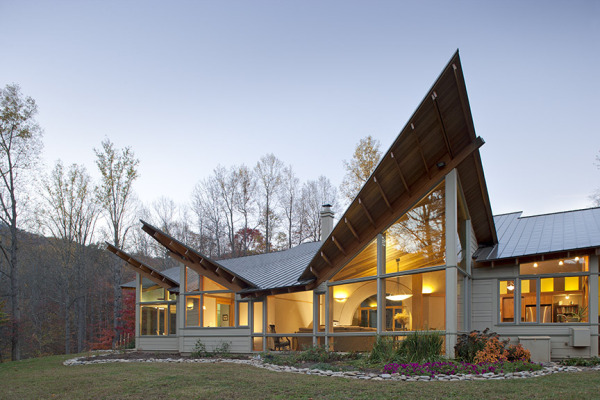
The clearing at the top of this gentle knoll boasts views of Hominy Valley on three sides and a fine close-in view of Mount Pisgah to the south. This net-zero, passive and active solar home was designed considering Vedic Architecture principles, with the main entrance facing due north and a small room for meditation facing due east. ‘Pop-up’ roofs lift up to the southern sky in three locations. These ‘pop-ups’ allow natural light and sky to penetrate deeply into the house, making it feel psychologically bigger, orienting its inhabitants to the natural world, blurring the line between indoors and out, and providing substantial aperture for solar heat gain. Often when entering a house where window headers are all placed at the standard 8 or 9 foot height, I find myself walking closer to the windows to get a view of the sky—its always comforting. Due to numerous renewable energy harvesting systems, this house is net-zero energy: it produces more energy than it uses over the course of a year.

In designing passive solar homes, another challenge is creating a home that looks, feels, and functions beautifully—and escapes the stigma of many early passive solar homes that often looked like machines for solar collection that somehow people lived in. 

Several large poplar trees, removed when clearing the house site, were later used as paneling for interior ceilings, exterior soffits and as window and door trim. Slab-on-grade construction provided an ideal and inexpensive way to include the interior thermal mass needed for passive solar heating. The mass in the slab also helps with passive cooling and is convenient for installing radiant floors as back-up heating. 

Additional programmatic requirements included seeing through the house in all four directions from the center of the house, that there be an archway somewhere between interior rooms, and that the active hot water solar panels and PV panels not be visible from the front of the house.


SIZE: 2720 sf conditioned space, 2 bedrooms, 2 bathrooms, plus freestanding Garage/Shop.

SITE SIZE: 11 Acres

COMPLETED: 2008

CONTRACTOR: Greenbrier Builders, Douglas Clark

INTERIORS: Lynne Law

STRUCTURAL: McDonald Structural Engineering, Eric McDonald

ACTIVE SOLAR: Sundance Power Systems

SUSTAINABLE FEATURES: Passive solar heating and cooling, slab-on-grade thermal mass with radiant tubing, interior stonework thermal mass, ground source geothermal heating and cooling, three 4x10 flat plate solar collectors for heating domestic hot water, 6.45Kw grid-tied photovoltaic system, energy recovery ventilator (ERV), Icynene insulation, interior trim and wood planking on ceilings and soffits milled from poplar trees removed from the house site, Southern Yellow Pine glue-laminated beams and columns, low VOC finishes, underground rain catchment system, permaculture landscaping

Chris Larson · Architect · 16 Whisper Creek Lane · Asheville · North Carolina · 828.253.4621 · © 2011